 AckuityRequest assessment
THE SOURCE
A useful direction, not a certification
NIST’s October 27 post proposes initial design tenets for agent identity systems. Its scope includes narrow delegation, temporary revocable authorization, separation of policy from reasoning, deterministic access decisions, monitoring and tamper-evident evidence. Probabilistic signals can inform decisions; they should not be the primary access mechanism. These are proposed directions, not a certification of any product. The practical tests below are Ackuity’s analysis, not a NIST test suite. They cover selected authorization concerns rather than all ten tenets or a complete conformance assessment.
THE EVALUATION
Start with a task contract
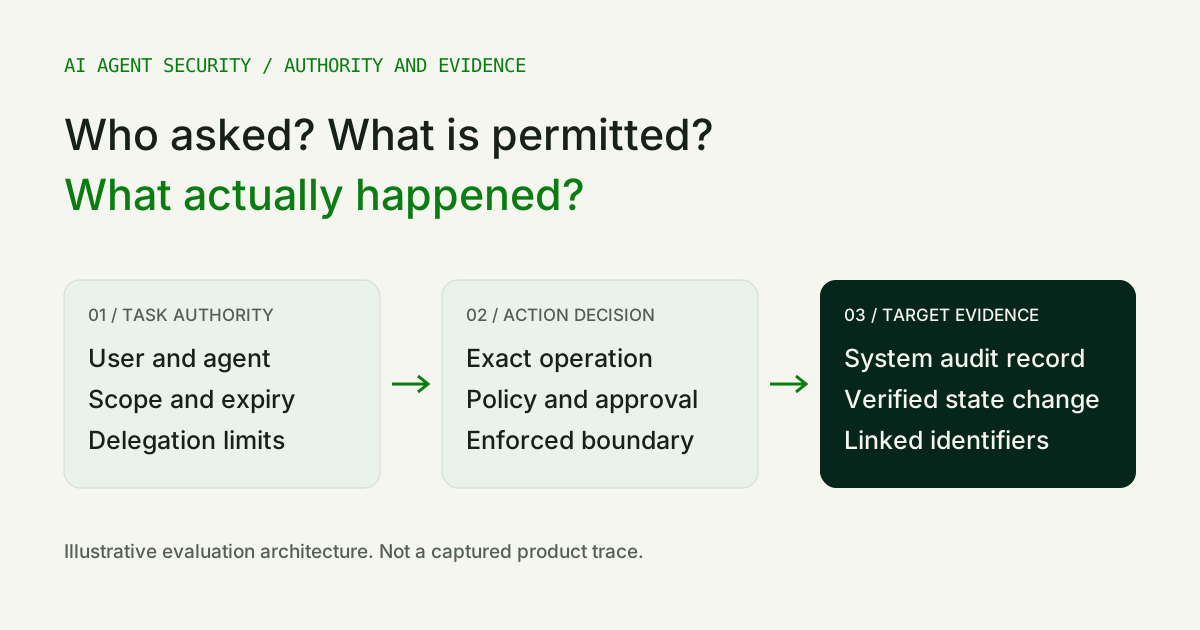
Imagine an internal agent preparing a quarterly finance summary. Before testing security, write down who requested it, which reporting period is in scope, which source systems are permitted, where the summary may be saved and when the task expires. This is a synthetic evaluation scenario. It does not describe a recorded Ackuity enforcement test. The contract gives reviewers something concrete to compare against a later action. “It used the right account” cannot by itself explain why a new recipient, destination or reporting period was acceptable. This task contract is an evaluation aid, not evidence of a cryptographically signed mandate or identity binding.
CHANGE THE SCOPE
Change one condition at a time
Run the permitted task first and retain the result. Then repeat it with one changed condition: the task has expired; the output destination belongs to another business unit; the reporting period expands; or a delegated worker asks for a capability the parent task never had. Record the expected result before executing each test. A useful control should preserve the legitimate workflow as well as handle the adverse case. Do not count a warning as a blocked operation. Do not count a tool success response as proof that the intended record changed.
REVIEW THE ACTION
Make approval specific enough to mean something
For an operation that needs review, show the reviewer the exact target, proposed effect and relevant task scope. Test what happens when those details change after approval. If a person approved saving a summary in a finance workspace, that approval should not silently become permission to export it elsewhere. Retain the reviewer decision and the subsequent action record. Where a boundary is a hard prohibition, an approval screen should not quietly turn it into an exception.
VERIFY THE EFFECT
Collect two sides of the story
Keep the agent-side request and authorization record, then compare them with target-system evidence. For a saved report, inspect the created object, destination and access settings. For a rejected write, inspect the relevant audit trail and bounded before/after state. Missing logs mean the outcome is unknown. They do not prove prevention. Correlation IDs, policy revisions, times and environment details make this evidence reviewable by someone who did not run the test. Use redacted task parameters and avoid collecting secrets or unnecessary personal information. Ask how records are protected from alteration by the acting agent, and verify that property in the tested deployment.
See how to connect the decision to target-system evidence. For the different problem of individually permitted calls forming an unsafe sequence, follow the complete workflow rather than treating each tool in isolation.
ASK FOR PROOF
Ask vendors to show the boundary
Ask which integration can enforce the tested action and which integration only observes events. Ask what happens when the decision service is unavailable, when an approval expires and when an operation takes a path the integration does not cover. Request evidence for the supported configuration rather than accepting a platform logo as universal coverage. Ackuity is the Agent Execution Control Switch. Its Agent Security Context Graph brings task and action context into the decision. Product-specific guarantees about the tests above require actual configuration and downstream evidence; this article makes no claim that all tests have been demonstrated.
NEXT STEP
Take the evaluation into your own environment
Use the existing agent security evaluation checklist and test kit to record the contract, expected result, observed decision and verified outcome. Start with a small isolated task, demonstrate that useful work succeeds, then change one boundary at a time. Teams that want help identifying exposure can request the 30-day Agent Exposure Assessment. Observation findings and inline enforcement tests should remain clearly distinguished.
These evaluation questions support a broader agent security review. Test only in an isolated environment you are authorized to use, with synthetic data and controlled destinations.